


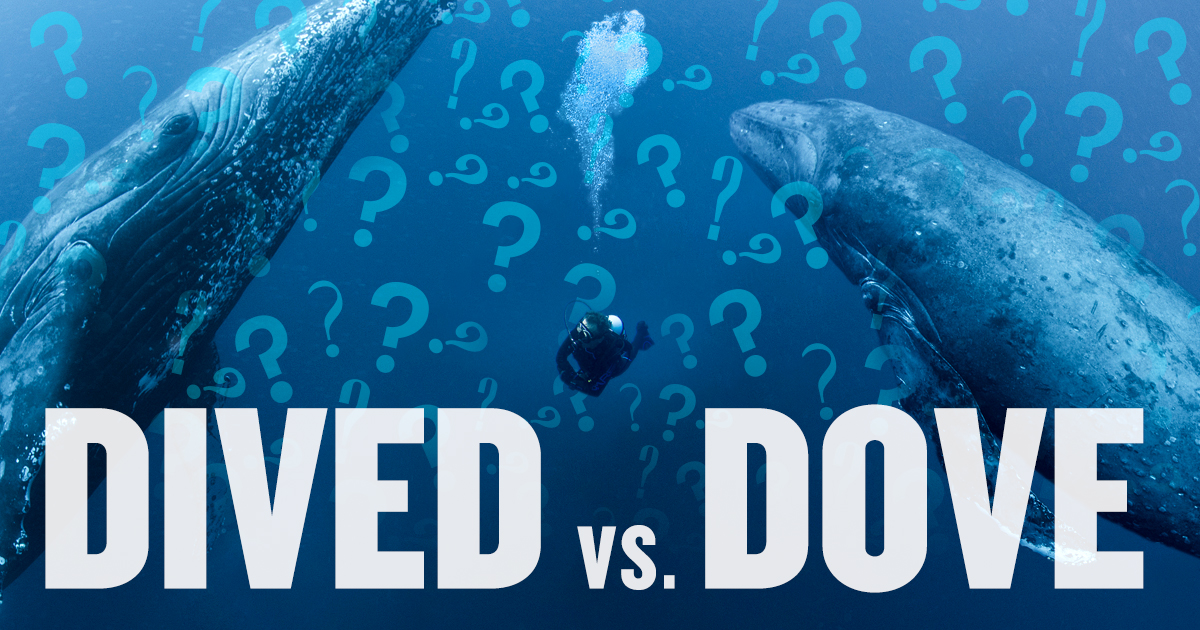
Editor’s Note: The opinions expressed below are those of Huish Outdoors copywriter Sam Morse. We understand that this is a divisive issue and we believe you should be able to conjugate your verbs freely, and without judgement.
Of all the controversies in diving, one of the most hotly contested, surprisingly, revolves around an issue of grammar. In English, verbs conjugate in many strange ways, and the word “dive” is no exception.
In the US, it can be quite difficult to get an accurate hold on what the correct past-tense usage is for the word. Growing up, every time the situation arose, grammar nerds would insist upon the proper usage being “dived.” And so I nodded in agreement.
But since I started diving in my early 20s, it’s always seemed strange that the casual past-tense usage, “dove” isn’t more colloquially popular.
Drive is to Drove as Dive is to Dove
After all, “I dove Arcos the other day” sounds a lot better than “I dived Arcos the other day,” but I digress. Perhaps the closest similarity in English is with the word “drive.” You drove to the supermarket, you didn’t drived there.
At least I hope you didn’t.
But everyone’s got an opinion, so we took this hard-hitting, if not entirely important, question to our social media community recently to hear what they had to say.
The most popular (not always the most appropriate) comment came from user Brian Pallock, who said he shuns both dived and dove—and opts for an unconventional alternative.
“I just tell everyone that I wetted myself,” he explains.
Commenter Tod Hay points out that the “dived” usage is the older of the two and comes from old British English, twang and all.
“For me, being from the US, it’s dove,” he writes. “It’s “dived” in the UK though. Although I’ve converted a few brits over to using “dove”.
As he continues to explain in the thread, during a dive trip, the brits all laughed at him initially when he said “dove”.
To be clear, at BARE we believe you’re free to conjugate however you please. The anti-dove cruelty has to stop.
However, Hay also reported that after 2-3 dive trips with the same British folks, they too converted and started saying “dove” instead of dived.
A Sport Dive-ided?
While some sought out the grammatical extremes of the spectrum, others cried for unity amid the uproar. “Either,” wrote BARE ambassador Joe Platko. “But this sure is a dive-ided topic!”
According to one of the gold-standards of the English language, Merriam-Webster, “the words dived and dove are interchangeable as a past tense and past participle of the verb dive. Both verb inflections are used in American and British English; however, dove is an Americanism, and thus tends to be used more in American English.”
So there you have it: there’s officially no wrong way, grammatically, to go diving in the past tense. Whether “dived” sounds good? That’s another story…
“But dove is a bird!” many commenters insisted.
“Sure,” pro-dove commenter Bernie Schaloske responded, “but bass is a fish, and an instrument, and a vocal register… English is complicated!”
After it’s all said and done, perhaps the most important thing is that you dove/dived, at all. And with that in mind, Oceanic has all of the dive and snorkeling essentials you could ever want. From bombproof dry bags, to the workhorse OceanPro BCD, to the BlueTooth-connected GEO 4.0 wrist computer, if the waters are calling, Oceanic can help you feel right at home.