


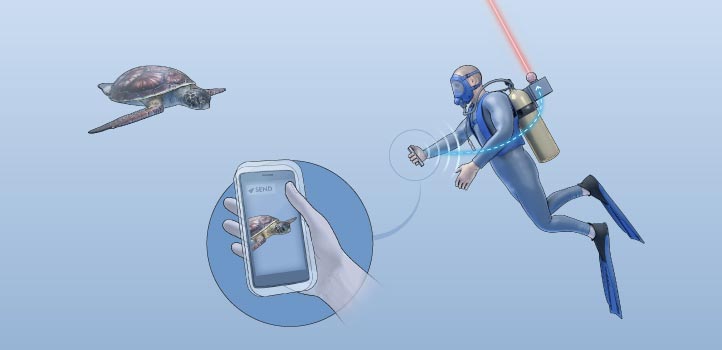
THUWAL, Saudi Arabia — The science, technology and diving fields were shaken up earlier this summer with the revelations that Saudi Arabia’s King Abdullah University of Science & Technology (KAUST) has been ironing out the kinks for a comprehensive underwater internet, or, “Aqua-Fi.”
If the research continues on its current trajectory, it may not be long before you can livestream from 20 meters and integrate true wireless connectivity into your dive computer.
Bassem Shihada, associate professor of computer science at KAUST and a lead researcher on the project said earlier this summer that he and his team are excited to be pioneering Aqua-Fi.
“This is the first time anyone has used the internet underwater completely wirelessly,” Shihada said in a statement. “The future of Aqua-Fi based network will be a scalable, flexible, and efficient communication solution for and with the underwater environment.”
The origins of the idea for Aqua-Fi stem from 2019 conversations between the KAUST team where they aspired to truly “connecting everything with everything.”
”We put together a vision on how to connect the underwater devices with the Internet,” Shihada continued. “Aqua-Fi will be the main element for the futuristic internet of underwater things network, where it will connect underwater stations, divers, autonomous vehicles, etc. with the terrestrial networks.
According to KAUST, in the real-world applications, Aqua-Fi would use radio waves to send data from a divers smartphone to a gateway device attached to their gear. Then, much like a booster that extends the WiFi range of a household internet router, this gateway sends the data via a light beam to a computer at the surface that is connected to the internet via satellite.”
But really, in layman’s terms, how does it work?
In early experimentation, KAUST says their Aqua-Fi prototype used green LEDs or a 520-nanometer laser to send data from a small, simple computer to a light detector connected to another computer. The first computer converts photos and videos into a series of 1s and 0s, which are translated into light beams that turn on and off at very high speeds. The light detector senses this variation and turns it back into 1s and 0s, which the receiving computer converts back into the original footage.
That’s a lot of moving parts and is far beyond the pay grade of most divers, which is why the technology is still on the horizon. But if Shihada and his team continue to find success in their pursuit of functional Aqua-Fi, we may soon begin to see all types of digital applications spread across the dive gear industry as the magnitude of the technology fully set in.
“We have created a relatively cheap and flexible way to connect underwater environments to the global internet,” Shihada said. “We hope that one day, Aqua-Fi will be as widely used underwater as WiFi is above water.”